

The guided path
- Create an Entity or choose an existing configuration.
- Choose a provider and enter its API key. OpenAI includes a chat default and
text-embedding-3-smallfor 768-dimensional memory. The wizard checks the model catalog and sends a small embedding probe. - Link a Railway project. Review the named worker, memory database, and
/app/datavolume before deploying. The wizard creates missing resources and sends credentials privately through the CLI. - Pair an authenticated worker endpoint and verify the connection. Open the AR app with the exact command printed by setup.
In the application
Choose New ngram to open the guided experience. Pair a saved worker or enter its URL and pairing token, choose a body and voice, then connect. The app verifies the authenticated worker before saving a body. A failed connection leaves your form open for correction.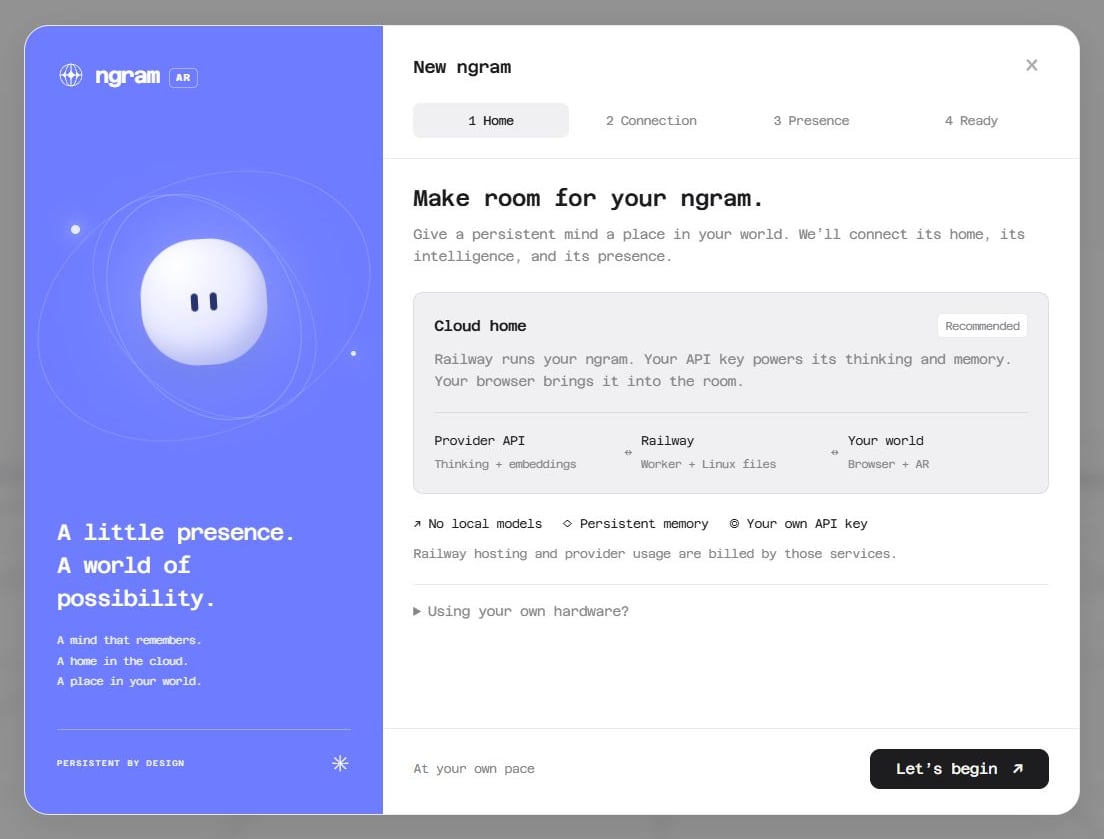
New ngram starts with the recommended cloud home: a provider API for thinking and embeddings, a Railway worker for memory and files, and your browser or headset for spatial presence.
Memory is part of the default
Embeddings power semantic recall. Postgres holds persistent experience and relationship data. The worker volume keeps knowledge, journal, body state, and files available across redeployments. Keep both storage resources attached. Pairing an existing worker preserves its memory settings. An OpenAI chat connection with existing embeddings can still depend on a home gateway. Equal vector dimensions do not make two embedding models compatible. The app blocks an onboarding switch to a different embedding model when existing memories are detected; migrate those memories deliberately before changing their vector space.Other profiles
Use
uv run ngram setup --profile hosted, --profile local, or --profile hybrid when you explicitly want these alternatives. Cloud setup does not overwrite a deployed Entity’s inference or memory configuration; use uv run ngram ar setup to pair an existing worker.